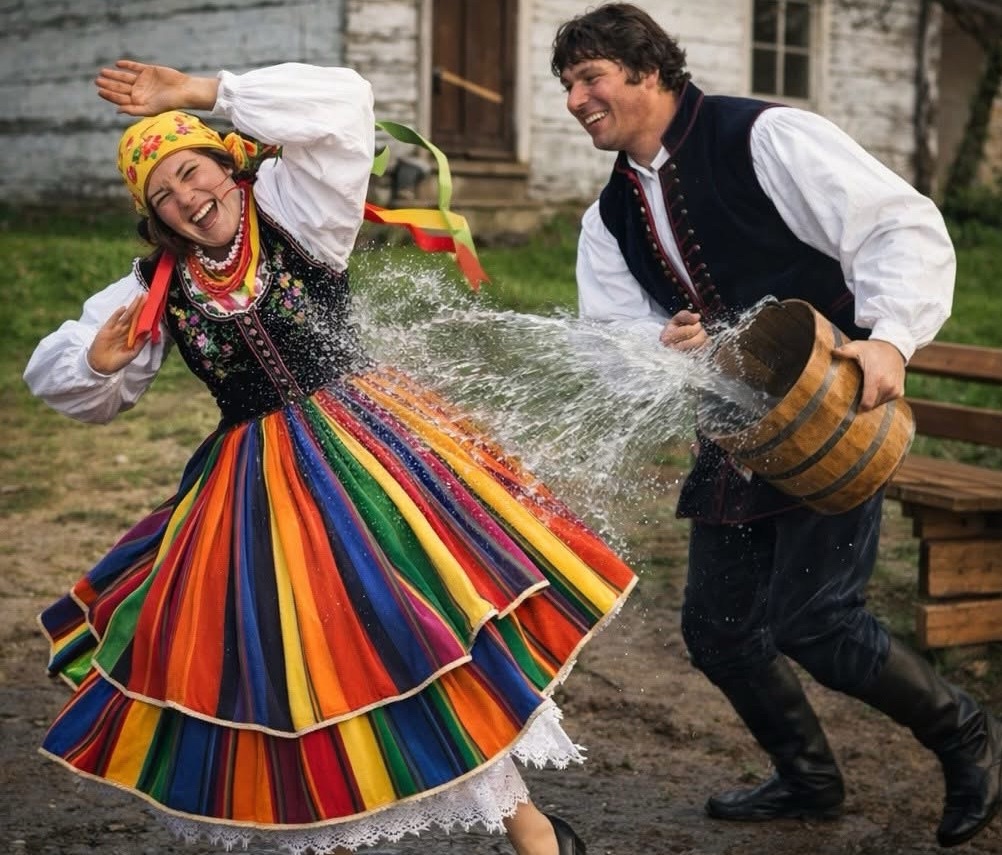
Easter Monday, known in Poland as Śmigus-Dyngus or Wet Monday, is one of the most joyful and recognisable Easter traditions. While today it is associated mainly with playful water splashing, its roots reach deep into ancient customs and the symbolism of renewal.
🌿 Where does this tradition come from?
The origins of Śmigus-Dyngus date back to pre-Christian times, when water symbolised purification, fertility, and new life. Spring rituals were meant to ensure health, prosperity, and a successful year ahead.
Over time, these customs became part of Easter celebrations — the feast of the Resurrection of Christ — giving them a deeper spiritual meaning connected with rebirth, hope, and renewal.
💧 What do “Śmigus” and “Dyngus” mean?
Originally, they were two separate traditions:
Śmigus involved gently splashing water or tapping with willow branches — a symbolic act of cleansing and blessing Dyngus referred to visiting homes and receiving small gifts, such as painted eggs or sweets
Eventually, these customs merged into the lively celebration we know today.
👨👩👧👦 A living family tradition
Today, Wet Monday is above all a day of laughter, joy, and togetherness. Children run around with water, families share moments of fun, and adults revisit cherished memories from their own childhood.
It is this sense of connection and shared experience that keeps the tradition alive across generations.
🇵🇱 A symbol of Polish identity
For Poles — both in Poland and across the diaspora — Śmigus-Dyngus is more than just a custom. It is a living expression of culture, heritage, and continuity.
In a rapidly changing world, traditions like this serve as a bridge between past and present, keeping identity and community strong.
✨ Joy with deeper meaning
Easter Monday reminds us that even the simplest gestures — a splash of water, a shared laugh — can carry profound meaning.
Because in tradition, in family, and in being together, there is something truly powerful.
Happy Easter Monday – Wet Monday! Alleluia! ✨



 Polish Sue
Leave a comment