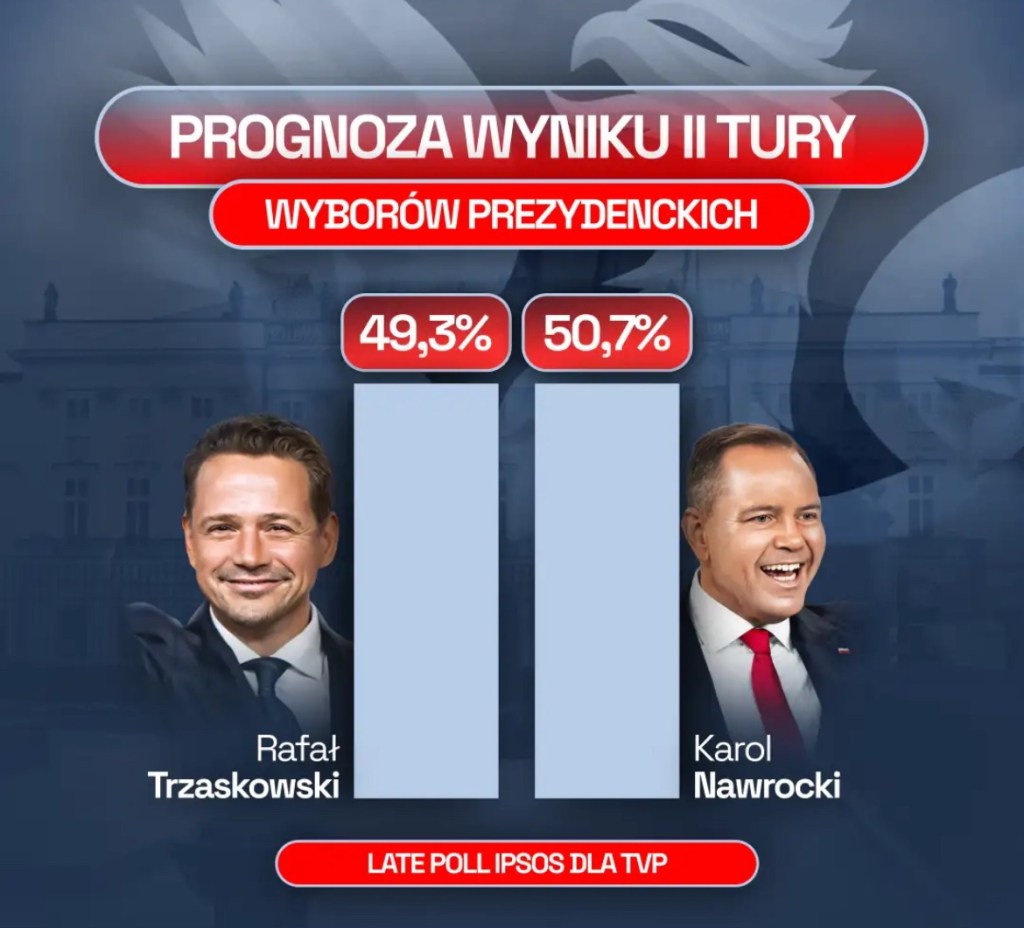
Just hours before Poles head to the ballot box, a late Ipsos poll shows conservative candidate Karol Nawrocki edging ahead in the presidential race with 50.7%, while Warsaw Mayor Rafał Trzaskowski holds 49.3%. The margin of error? 0.5%.
In other words: this election is still anyone’s game.
Nawrocki, a historian and head of the Institute of National Remembrance (IPN), represents a continuation of Poland’s nationalist and conservative legacy — one rooted in sovereignty, Catholic values, and a particular vision of 20th-century history. If he wins, we can expect a presidency that fiercely defends Poland’s wartime narrative and challenges liberal currents in both domestic and EU affairs.
On the other hand, Trzaskowski embodies a “progressive, modern Poland — urban, outward-looking, and socially liberal”. His campaign appeals to younger voters, centrists, and those exhausted by polarization. If he manages a last-minute surge, it will reflect a shift toward greater integration with Europe and civil society reforms.
But here’s what’s really striking: the country remains split almost exactly in half. A 1.4% difference is within the statistical margin of error. The final result could hinge on: turnout in rural vs. urban areas, late-deciding voters, and Poles voting abroad.
Whatever the outcome, the election will shape Poland’s future — its role in the EU, its stance on Ukraine, its historical memory, and the tone of political life at home.
History is being written — again
 Polish Sue
Leave a comment