A historical debate in London – 13 November 2026.
Understanding the origins of Communist Poland requires looking beyond the end of the Second World War. It is a story of Soviet imperial ambitions, the destruction of Polish sovereignty, political deception and the courage of a nation that refused to surrender its independence.
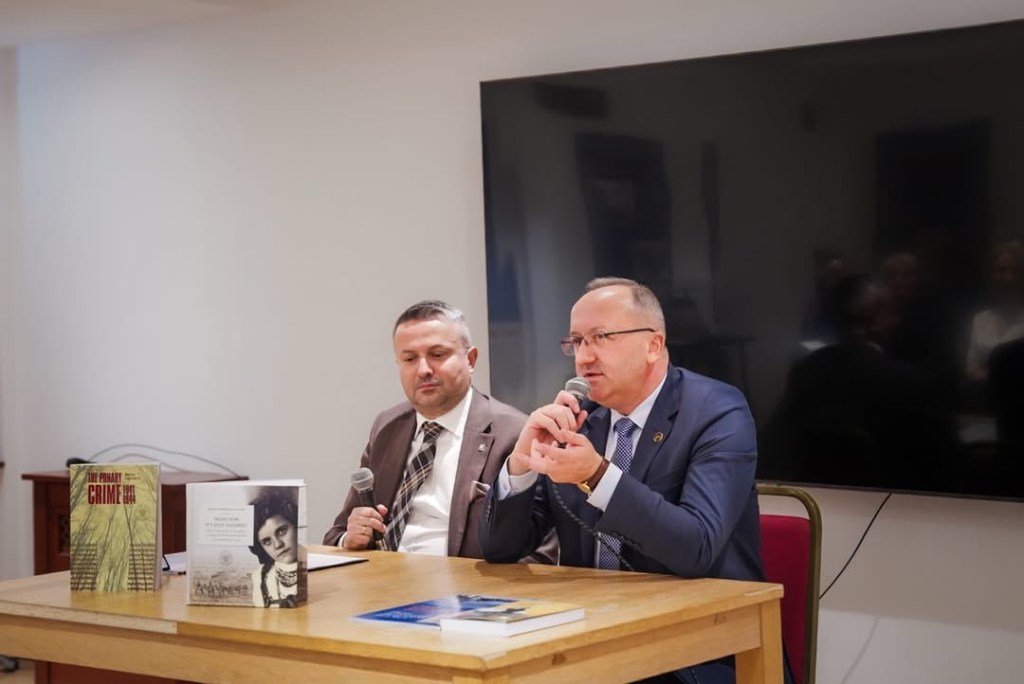
On 13 November 2026, the Polish Library at the Polish Social and Cultural Association (POSK) in London hosted an important historical debate entitled “The Origins of ‘People’s Poland’ – On the Road to a New Enslavement”. The event brought together distinguished historians from the Institute of National Remembrance (IPN), offering an opportunity to revisit one of the most consequential and painful periods in modern Polish history.
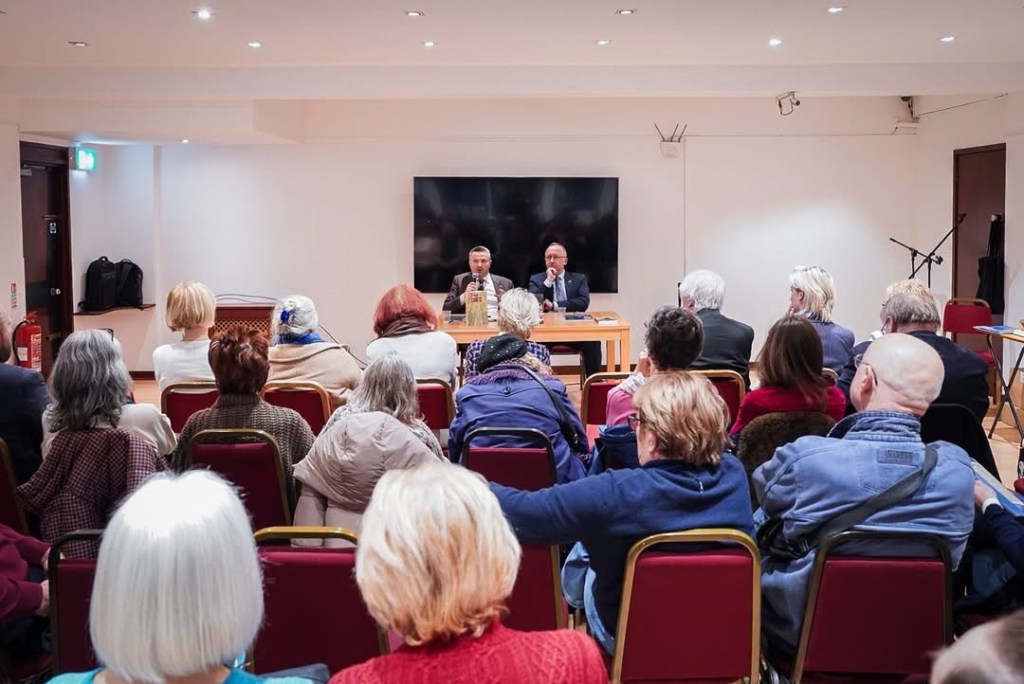
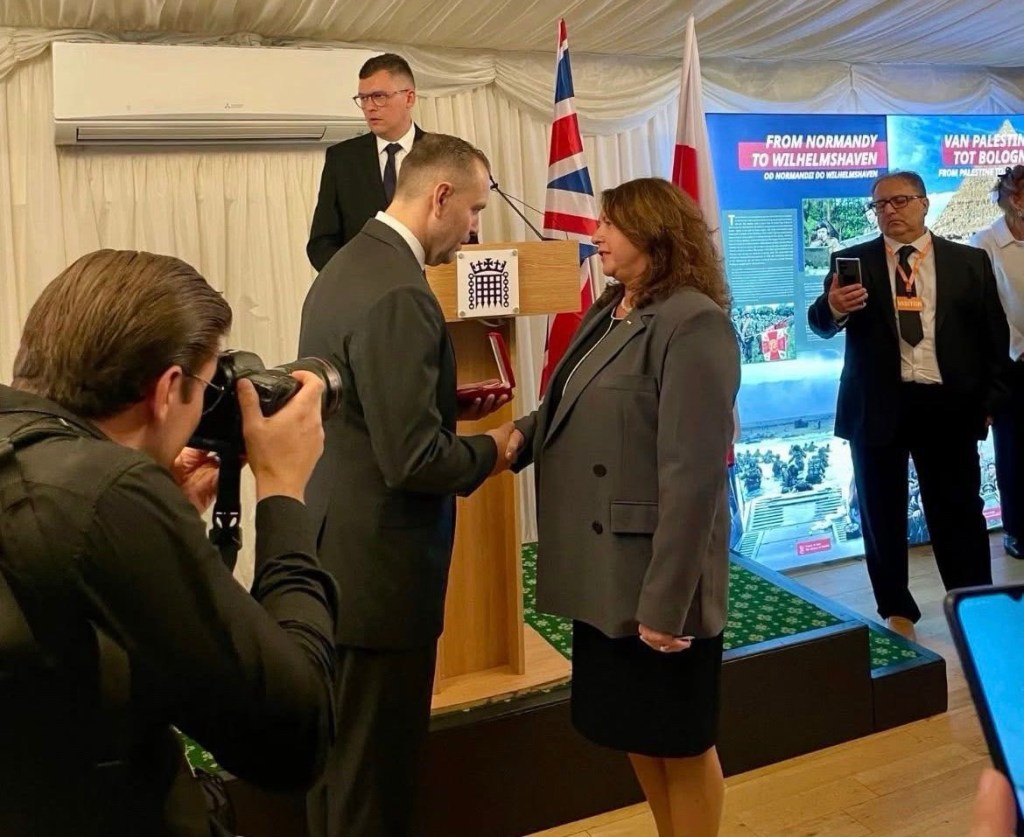
The discussion was attended by Dr hab. Karol Polejowski, Deputy President of the Institute of National Remembrance, and Dr Sebastian Pilarski, Director of the IPN Historical Research Office. The meeting was opened by Dr Dobrosława Platt, Director of the Polish Library at POSK.
For the Polish community in Britain, and particularly for younger generations born outside Poland, understanding this history is essential. The establishment of Communist Poland was not simply a change of government following the defeat of Nazi Germany. It marked the beginning of another period in which Poland’s independence was severely restricted and its political future determined by a foreign power.
From the Bolshevik ambitions of 1920 to Stalin’s post-war plans
The origins of Communist Poland cannot be understood without looking back to the Polish-Bolshevik War of 1919–1921.
In 1920, Soviet Russia attempted to bring Poland under Communist rule and extend the Bolshevik revolution towards Western Europe. The creation of the Provisional Polish Revolutionary Committee (Polrewkom), established under Soviet protection, demonstrated that Moscow already had a model for imposing a supposedly Polish government on the country.
The committee announced plans for a Polish Soviet Socialist Republic. Its political programme, prepared in Moscow, envisaged the abolition of private property, nationalisation and the transformation of Polish society along Bolshevik lines.
These ambitions were defeated by the Polish victory in the Battle of Warsaw in August 1920, often remembered as the Miracle on the Vistula.
However, the Soviet ambition to control Poland did not disappear.
Almost a quarter of a century later, under Joseph Stalin, a similar strategy was implemented with far greater success. This time, the instrument was the Polish Committee of National Liberation (PKWN), established in July 1944 under Soviet supervision.
Although presented as a legitimate Polish authority, the PKWN was dependent on Moscow. Its manifesto, like that of Polrewkom in 1920, was prepared in the Soviet capital.
The historical parallel is striking: what the Bolsheviks had failed to achieve militarily in 1920, Stalin succeeded in imposing through military occupation, political manipulation and the systematic destruction of independent Polish institutions.
1939–1945: The destruction of Polish sovereignty
The Soviet domination of post-war Poland must also be viewed in the context of the Molotov–Ribbentrop Pact of August 1939, the joint German-Soviet invasion of Poland and the Soviet attack of 17 September 1939.
The occupation of Poland’s eastern territories between 1939 and 1941 brought mass deportations, repression, executions and the systematic destruction of Polish institutions. The Katyń Massacre became one of the most devastating symbols of Soviet brutality against the Polish nation.
When Germany invaded the Soviet Union in June 1941, the political circumstances changed, but Stalin’s strategic ambitions towards Poland remained.
As the Red Army advanced westwards, the Soviet leadership increasingly undermined the legitimate Polish authorities, both in exile and within occupied Poland. Moscow promoted institutions that claimed to represent the Polish nation while remaining subordinate to Soviet interests.
The Warsaw Uprising of 1944 and the subsequent destruction of the Polish capital further weakened the country’s independent political and military structures.
By the time Soviet forces entered the ruins of Warsaw in January 1945, much of the Polish underground state had already been dismantled or severely weakened.
1944–1945: Liberation or a new occupation?
One of the central historical questions raised by the London debate concerned the meaning of the Soviet advance into Poland.
Although Soviet propaganda presented the Red Army’s arrival as liberation from Nazi Germany, the reality was considerably more complicated.
The defeat of Nazi Germany did not restore full Polish independence. Instead, the country found itself under Soviet military and political domination.
The presence of the Red Army and the NKVD facilitated the destruction of the Polish Underground State, particularly the Home Army (Armia Krajowa), and the establishment of Communist administrative structures.
Polish soldiers who had fought for their country’s independence were arrested, interrogated, deported and, in many cases, murdered. Members of the resistance were treated as enemies by the new authorities, despite their contribution to the struggle against Nazi occupation.
The Soviet security apparatus operated alongside the emerging Polish Communist administration. Soviet officers acted as advisers within the security services and military structures, while Moscow retained decisive influence over political and strategic decisions.
The so-called Polish authorities were therefore not genuinely sovereign. Their power depended on Stalin’s approval and the continued presence of Soviet military and security forces.
The country also suffered extensive economic exploitation. Industrial equipment, railway infrastructure, agricultural resources, machinery and cultural property were confiscated and transported eastwards. Entire production lines were dismantled and removed to the Soviet Union.
This was not simply a political transformation. It was the imposition of a new system of dependency, backed by military force and repression.
The falsification of democracy: The referendum of 1946
A particularly important part of the history of Communist Poland was the so-called People’s Referendum, held on 30 June 1946.
The referendum was intended to demonstrate popular support for the new political order. However, the results were falsified by the Communist authorities, with Soviet support and supervision.
The manipulation of the referendum was a crucial step towards consolidating Communist power. It destroyed one of the last opportunities for a genuinely democratic political process in post-war Poland.
The Communist authorities used propaganda, intimidation, arrests and electoral manipulation to eliminate political opposition and establish a one-party dictatorship.
The subsequent parliamentary elections of January 1947 were also heavily manipulated.
For Poland, this meant that the promise of freedom following the defeat of Nazi Germany had been replaced by another form of political enslavement.
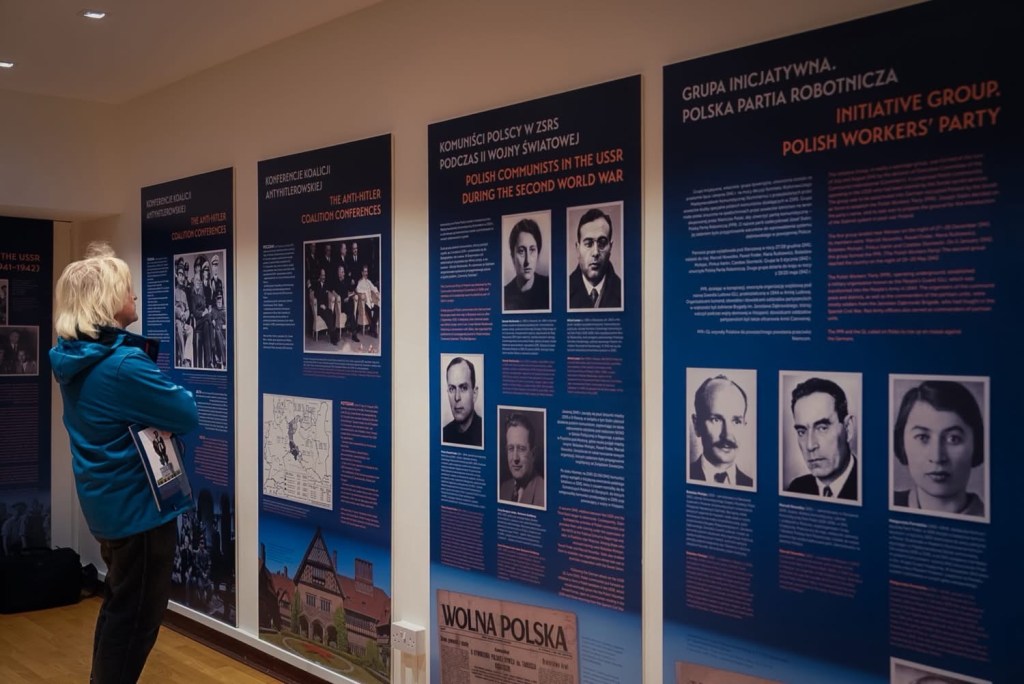
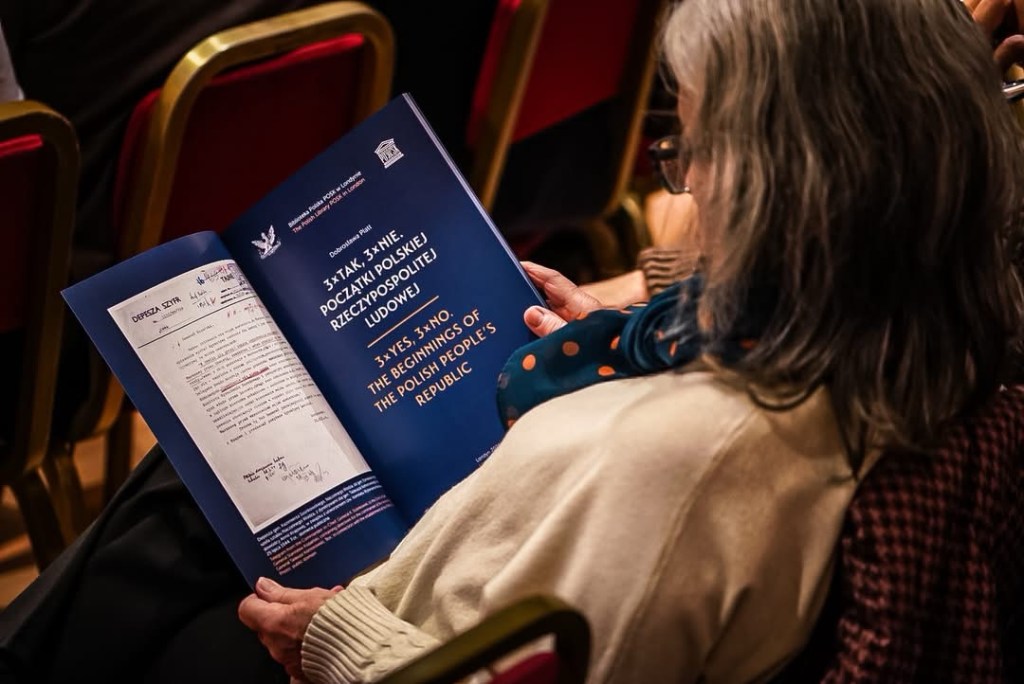
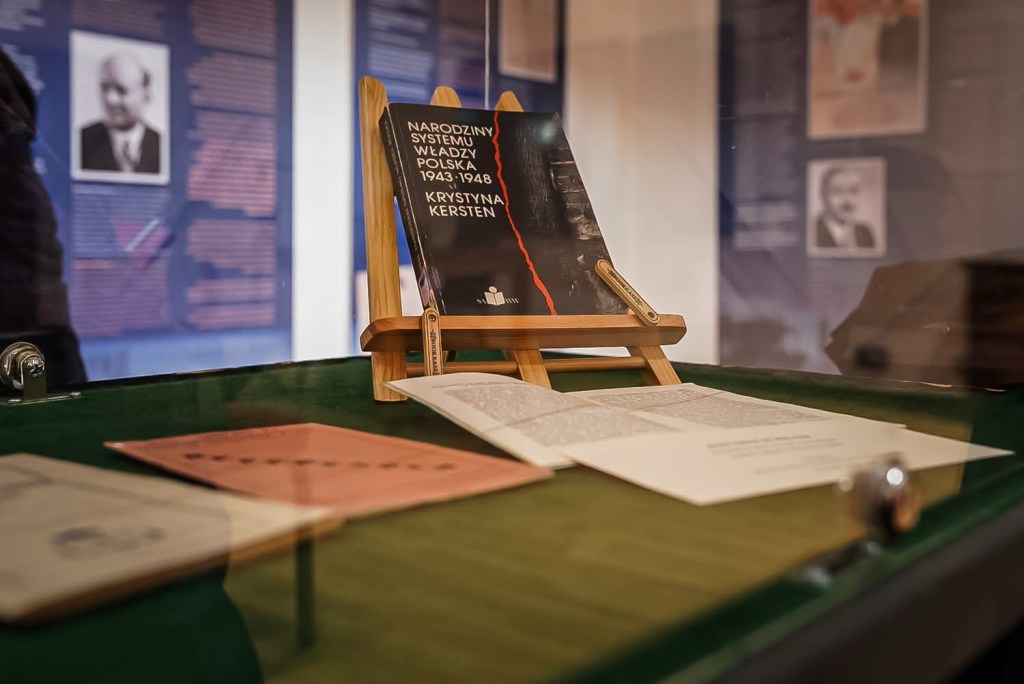
The exhibition accompanying the London debate, entitled “3 x YES, 3 x NO. The Beginnings of the Polish People’s Republic”, explored these events in the context of the 80th anniversary of the falsified referendum.
The exhibition also included historical publications from the collections of the Polish Library at POSK.
It can be viewed in the Hall of Eagles at POSK in London until 31 January 2027.
Yalta, Potsdam and the international abandonment of Poland
The international dimension of Poland’s post-war fate is equally important.
At the Yalta Conference in February 1945, the future of Poland was discussed by the leaders of the Allied powers. Despite promises of free and democratic elections, the country remained firmly within the Soviet sphere of influence.
The Potsdam Conference, held between July and August 1945, marked another decisive stage. Most Western governments subsequently withdrew diplomatic recognition from the legitimate Polish Government-in-Exile and established relations with the Communist authorities in Warsaw.
The Polish Government-in-Exile, which had represented the continuity of the constitutional Polish state throughout the war, was increasingly marginalised internationally.
The transfer of diplomatic recognition did not mean that the Communist authorities had obtained genuine democratic legitimacy. Rather, it reflected the new geopolitical realities of post-war Europe and the growing dominance of the Soviet Union.
Poland had paid an enormous price for its wartime alliance with the Western powers, yet it did not regain the independence for which so many Poles had fought.
A history of resistance and national memory
The creation of Communist Poland was not an inevitable or universally accepted outcome. It was resisted by thousands of Poles who refused to recognise the legitimacy of the new regime.
The anti-Communist underground continued its struggle after the war. Many former Home Army soldiers and members of the Polish Underground State remained active, defending the idea of an independent Poland despite overwhelming odds.
Others were forced into exile, joining the Polish diaspora across Britain and the wider world.
The Polish community in the United Kingdom has a particular responsibility to preserve this history. Britain became home to many Polish servicemen, political leaders, intellectuals and families who refused to return to a country deprived of its sovereignty.
Their experiences form an important part of the history of post-war Britain as well as Poland.
Why this history matters today
The London debate was more than an academic discussion. It was a reminder that national independence cannot be taken for granted and that historical truth must be protected against political manipulation.
Understanding the origins of Communist Poland means recognising the difference between the defeat of Nazi Germany and the restoration of Polish sovereignty. It means acknowledging the Soviet Union’s decisive role in imposing Communist rule, the falsification of democratic processes, the repression of Polish patriots and the loss of genuine political independence.
For Polish Sue, whose mission is to promote Polish history, historical memory and education, particularly among younger generations in the United Kingdom, such initiatives are especially important.
History should not be reduced to dates and political agreements. It should also tell the stories of people who experienced occupation, resisted oppression, lost their freedom and continued to believe in an independent Poland.
The events of 1944–1947 remind us that the end of one occupation does not necessarily mean the beginning of freedom.
Poland’s history after 1945 is a powerful lesson in the price of sovereignty, the consequences of great-power politics and the enduring determination of a nation to remain free.
Polish Sue Association – Preserving Polish History, Heritage and National Memory in the United Kingdom.
Photo: Mateusz Niegowski (IPN).
Text: Iwona Golińska, Polish Sue
Source: IPN


Leave a Reply