When the Iron Lady arrived in communist Poland, she encountered a country still struggling for freedom. A mysterious banner above the streets of Warsaw, flowers laid at the grave of a murdered priest, and a meeting with Lech Wałęsa and the leaders of the banned Solidarity movement turned an official diplomatic visit into a powerful demonstration of international solidarity.
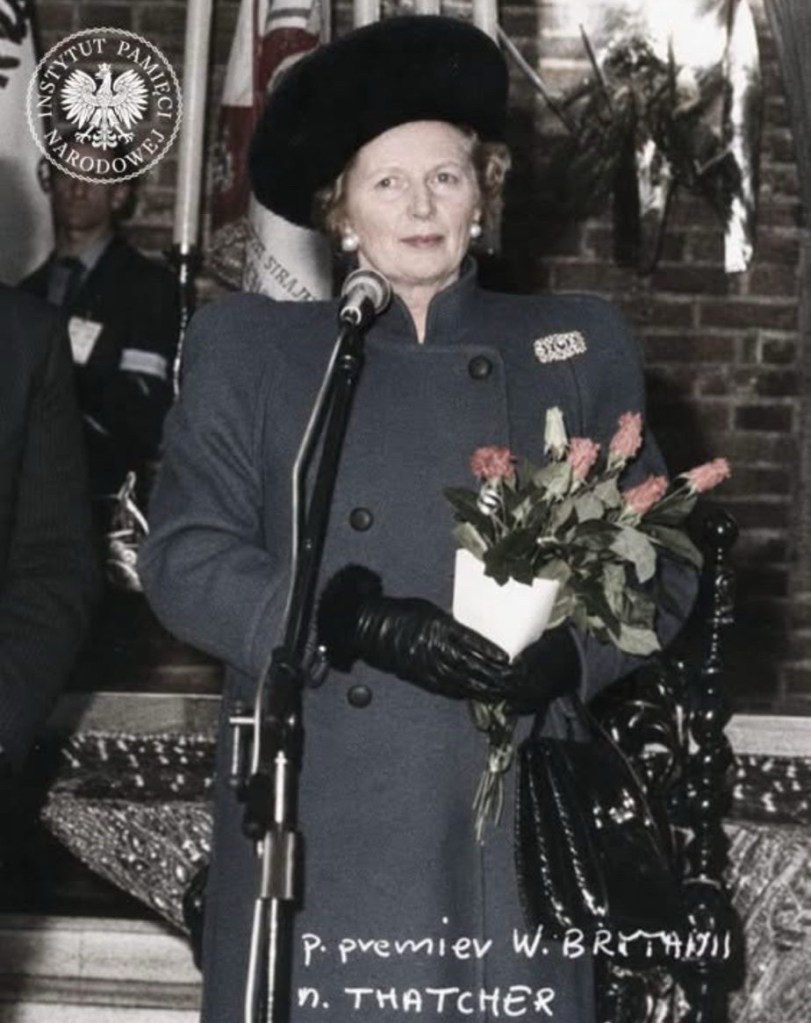
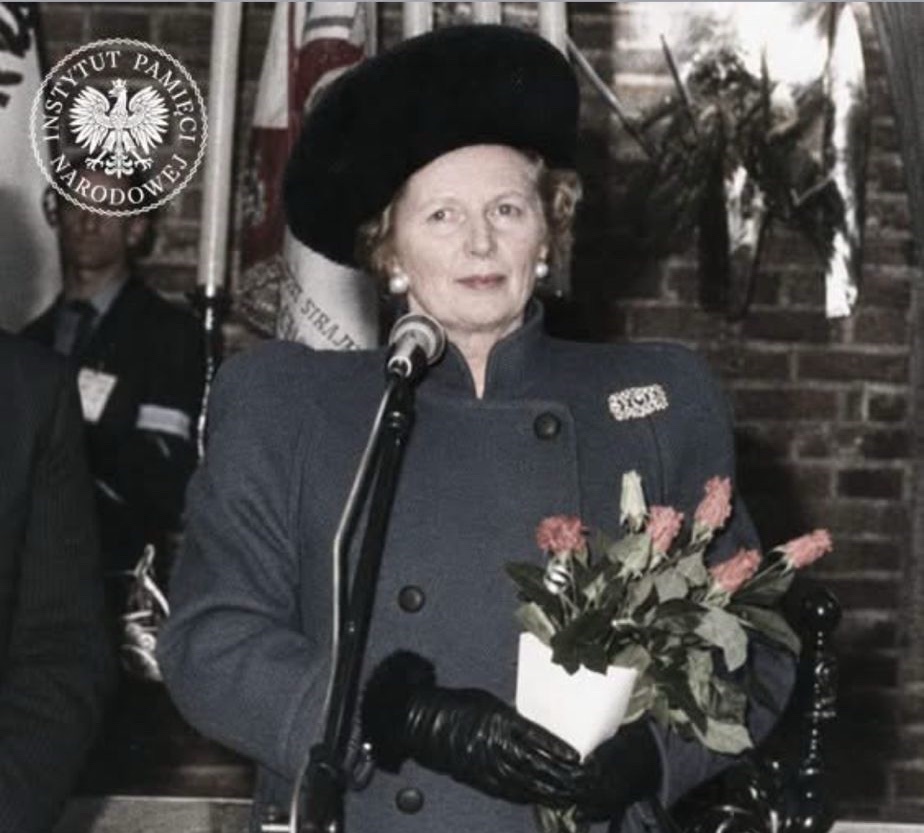
In November 1988, British Prime Minister Margaret Thatcher made a historic three-day visit to Poland. She was the first serving British Prime Minister ever to visit the country. Yet, beyond the official diplomatic meetings, her journey became an important moment in the history of Poland’s struggle against communism.
Poland was approaching a decisive turning point. Nearly four decades of communist rule had left the country facing economic collapse, widespread dissatisfaction and growing public unrest. The independent trade union Solidarity (Solidarność), established in 1980 and outlawed following the introduction of martial law in December 1981, continued to represent the hopes of millions of Poles seeking freedom, democracy and national independence.
Although the communist authorities were increasingly under pressure to negotiate with the opposition, the future remained uncertain.
For General Wojciech Jaruzelski and his government, Thatcher’s visit offered an opportunity to improve relations with the West and obtain support for economic reforms. For the democratic opposition, however, it was an opportunity to remind the international community that Poland’s struggle for freedom was far from over.
“Margaret, Beware of the Red Spider!” – A message from the streets of Warsaw
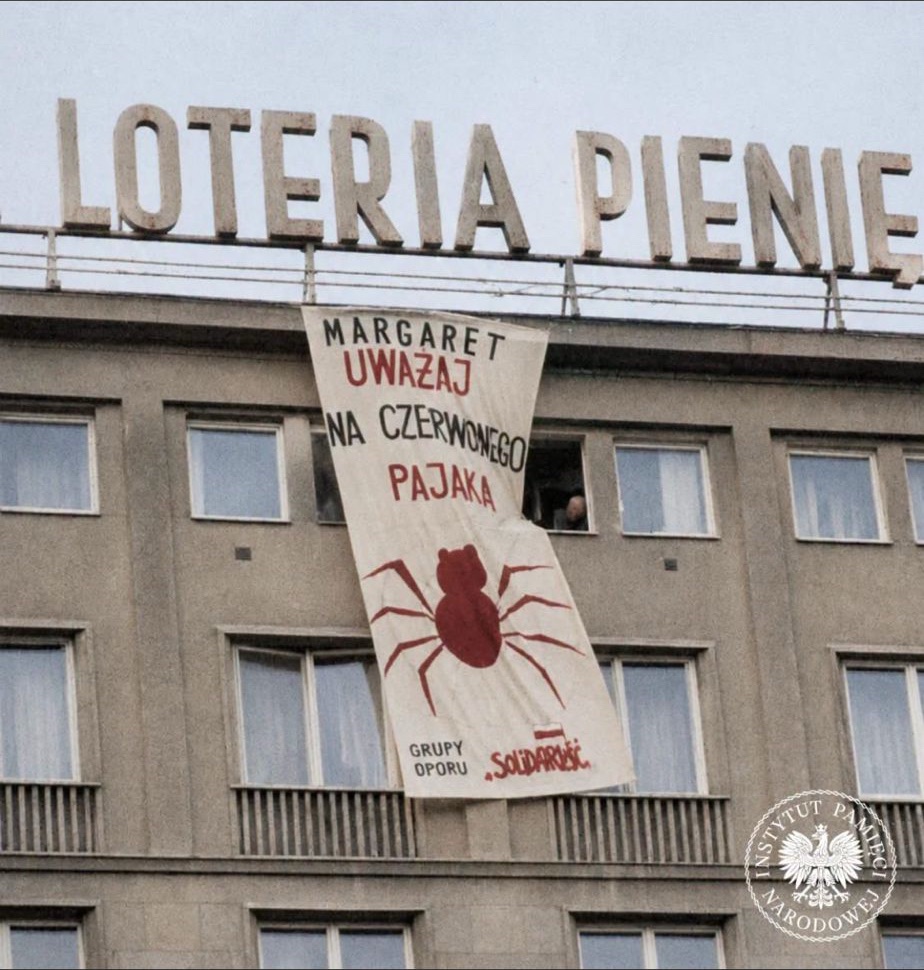
On 2 November 1988, as Margaret Thatcher’s motorcade travelled through Warsaw, anti-communist activists belonging to the underground resistance organisation Grupy Oporu „Solidarni” (Solidarni Resistance Groups) staged a remarkable protest.
At the junction of Krucza Street and Aleje Jerozolimskie, activists scattered hundreds of leaflets criticising the communist regime. Above the street, they displayed a large banner depicting a spider, accompanied by a message in English:
“Margaret, beware of the red spider!”
The banner remained visible for approximately 40 minutes. Its message was unmistakable: behind the carefully organised official welcome, Poland remained under the control of an oppressive communist system.
The protest was particularly daring given the extensive security operation surrounding the Prime Minister’s visit.
The communist Security Service (Służba Bezpieczeństwa – SB) had prepared an operation codenamed „Albion”, deploying considerable resources to monitor Thatcher’s movements, control public demonstrations and restrict her contacts with opposition representatives.
Yet the message of the underground resistance reached its intended audience.
A visit the communist authorities could not fully control
Thatcher’s official programme included meetings with General Wojciech Jaruzelski and Prime Minister Mieczysław Rakowski. However, some of the most memorable moments of her visit took place away from the formal diplomatic setting.
One of her most significant gestures was laying flowers at the grave of Father Jerzy Popiełuszko, the Catholic priest and chaplain of Solidarity who had been brutally murdered in October 1984 by officers of the communist Security Service.
Father Popiełuszko had become a symbol of courage, faith and resistance against political oppression. His words, „Zło dobrem zwyciężaj” – overcome evil with good – resonated deeply throughout Polish society.
More on Father Jerzy Popiełuszko on the link:
Thatcher’s tribute was therefore much more than a ceremonial gesture. It was a public expression of respect for a man whose death had exposed the brutality of the communist authorities.
She also visited Warsaw’s Hala Mirowska market, where ordinary citizens had an opportunity to greet the British Prime Minister. Her presence among ordinary Poles offered a glimpse of a society whose aspirations could not be contained by official communist propaganda.
Gdańsk – The birthplace of Solidarity
On 4 November, Margaret Thatcher travelled to Gdańsk, the city that had become synonymous with the Polish struggle for freedom.
It was here, in August 1980, that workers at the Lenin Shipyard began the strikes which led to the creation of Solidarity – the first independent trade union in the Soviet-controlled Eastern Bloc.
Thatcher began her Gdańsk programme by commemorating the Polish defenders of Westerplatte, whose resistance against the German invasion on 1 September 1939 marked the beginning of the Second World War.
She subsequently visited the Gdańsk Shipyard, where she was welcomed by workers carrying Solidarity flags and banners demanding political change.
Some of the messages were written in English, including calls for a revision of the Yalta agreements – a reminder of Poland’s post-war loss of sovereignty and its subordination to Soviet domination.
Together with Lech Wałęsa, Thatcher laid flowers at the Monument to the Fallen Shipyard Workers of 1970, commemorating the workers killed when communist authorities violently suppressed protests along Poland’s Baltic coast.
The monument itself had become one of the most important symbols of resistance and remembrance in modern Polish history.
At St Bridget’s Church, Thatcher met Lech Wałęsa and other representatives of the Solidarity leadership. She expressed her support for the legalisation of the independent trade union and for the democratic aspirations of the Polish people.
Her choice of clothing also attracted attention. During her meetings with representatives of the opposition, Thatcher wore green, a colour associated with hope in Poland.
Thousands of people gathered to welcome her. For many, this was an extraordinary opportunity to see a Western democratic leader openly acknowledge their struggle and recognise Solidarity as a legitimate representative of Polish society.
The Iron Lady and the Polish struggle for freedom
Margaret Thatcher’s visit carried a message that extended far beyond the diplomatic relationship between Britain and Poland.
She made clear that economic reform could not be separated from political freedom. Financial assistance and improved relations with Western countries would not, in themselves, resolve Poland’s crisis without genuine political change.
For the communist leadership, this was an uncomfortable message.
For the opposition, however, the visit represented an important demonstration that Poland had not been forgotten by the democratic world.
Thatcher’s support also reflected her broader political conviction that freedom, democracy and national sovereignty were fundamental principles that should not be compromised.
Just a few months later, in February 1989, negotiations between the communist authorities and the opposition began at the Round Table. These talks paved the way for the partially free parliamentary elections of 4 June 1989, which marked a decisive step towards the end of communist rule in Poland.
The transformation of Poland was the result of years of courage, sacrifice and determination by Polish society, particularly the workers, underground activists, intellectuals and members of Solidarity. International support played an important role, but it was the Polish people themselves who drove the struggle for change.
A friendship remembered across generations
Looking back, Margaret Thatcher’s November 1988 visit remains an important chapter in the history of Polish-British relations.
She arrived as a guest of the communist authorities, but she also made time to meet those who opposed the regime, honour a murdered priest and stand alongside the workers whose movement had challenged the foundations of communist power.
The image of the Iron Lady at the Gdańsk Shipyard, laying flowers alongside Lech Wałęsa, became a powerful symbol of international solidarity with the Polish nation.
And perhaps the most memorable image remains that mysterious banner above a Warsaw street:
“Margaret, beware of the red spider!”
It was a message from those who refused to surrender their freedom, even when the state tried to silence them.
For Polish Sue, preserving and sharing such stories is an essential part of keeping the history of Poland’s struggle for independence alive – particularly for younger generations growing up in Britain, who should understand the sacrifices made by those who fought for the freedoms we enjoy today.
The story of 1988 reminds us that freedom is never simply given. It is defended, demanded and won through courage, solidarity and the determination of ordinary people.
Polish Sue – Preserving Polish History, Inspiring Future Generations.
Source: IPN
Photo: IPN


Leave a Reply