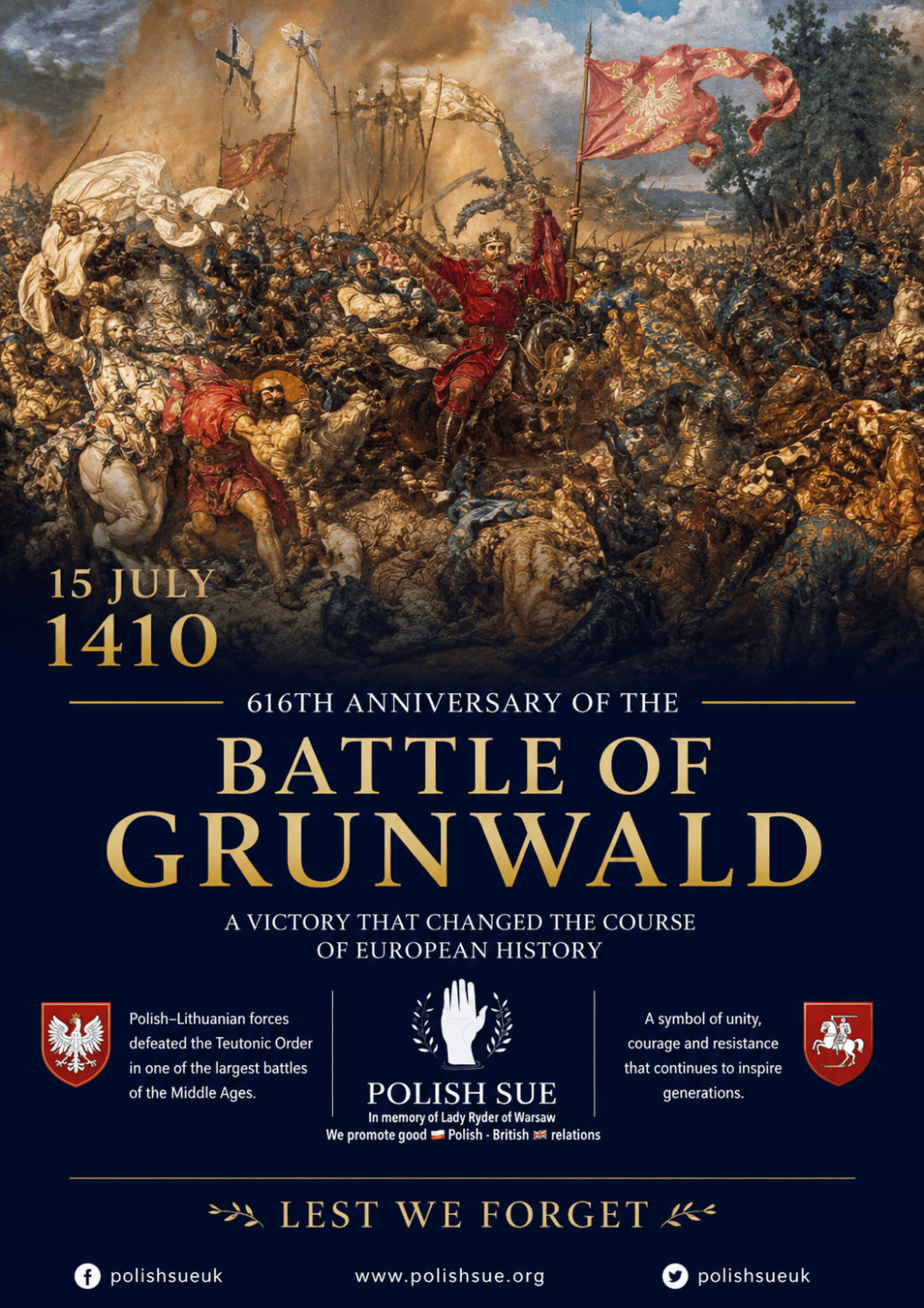
15 July 1410 marks the 616th anniversary of the Battle of Grunwald—one of the greatest and most decisive battles of the Middle Ages, in which the allied forces of the Kingdom of Poland and the Grand Duchy of Lithuania defeated the powerful Teutonic Order.
Led by King Władysław II Jagiełło and Grand Duke Vytautas, the Polish-Lithuanian alliance, supported by troops from across Central and Eastern Europe, faced the army of the Teutonic Knights under Grand Master Ulrich von Jungingen. Historians estimate that around 60,000 soldiers participated in the battle, making it one of the largest military engagements of medieval Europe.
The victory at Grunwald fundamentally altered the balance of power in Central and Eastern Europe. It marked the beginning of the decline of the Teutonic Order as a regional military power and strengthened the position of the Polish-Lithuanian alliance for generations to come.
One remarkable aspect of the aftermath was King Jagiełło’s decision to order that the bodies of Grand Master Ulrich von Jungingen and the Order’s highest-ranking commanders be recovered from the battlefield and returned with full military honours to the Teutonic capital of Malbork. This act reflected the medieval code of chivalry and demonstrated respect even for a defeated enemy.
For centuries, the Battle of Grunwald remained a powerful symbol of courage, unity and resilience. During the Partitions of Poland, when the Polish state disappeared from the map of Europe, the memory of Grunwald inspired generations of Poles to preserve their national identity and hope for the restoration of independence. It became a symbol of resistance against foreign domination and a reminder that freedom could be regained through determination and unity.
The battle has also left a lasting legacy in Polish culture. It inspired Jan Matejko’s monumental painting The Battle of Grunwald and Henryk Sienkiewicz’s novel The Knights of the Cross, both of which helped shape historical memory and patriotic identity.
Today, thousands of history enthusiasts gather every July on the Fields of Grunwald to witness one of Europe’s largest historical reenactments. The event attracts participants and visitors from around the world, keeping alive the memory of a battle that helped shape the history of Europe more than six centuries ago.
As we commemorate the 616th anniversary of the Battle of Grunwald, we honour not only a remarkable military victory but also the enduring values of courage, cooperation and the defence of freedom that continue to inspire future generations.
Lest we forget.
Polish SUE – Promoting Polish history and heritage in the United Kingdom.
 Polish Sue
Leave a comment