
23 July marks the 163rd anniversary of the birth of Tadeusz Wenda, the brilliant engineer whose vision transformed a small fishing village into one of Europe’s most modern ports.
Thanks to his determination and expertise, the Port of Gdynia became one of the greatest achievements of the Second Polish Republic and a symbol of Poland’s economic independence.
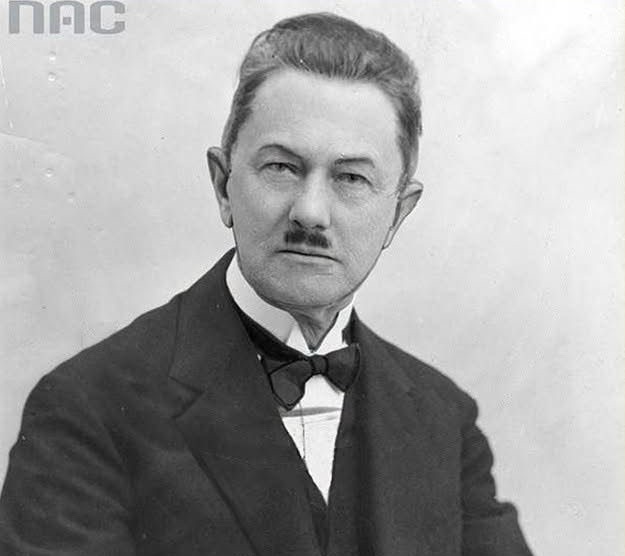
When Poland regained its independence in 1918 after 123 years of partitions, access to the Baltic Sea became essential for the country’s economic future. However, the city of Gdańsk (Danzig) was established as the Free City of Danzig under the Treaty of Versailles and remained outside Poland’s full control. It quickly became clear that the newly reborn Polish state needed its own modern seaport.
The responsibility for finding the perfect location fell to Tadeuszu Wenda, an experienced civil and maritime engineer. Before returning to Poland, Wenda had gained extensive experience designing and modernising ports in the Russian Empire, including projects in Windau (today’s Ventspils, Latvia) and Reval (modern Tallinn, Estonia), as well as bridges and harbour facilities.
After conducting detailed surveys of Poland’s Baltic coastline, Wenda concluded that the small Kashubian village of Gdynia offered the ideal natural conditions for a deep-water harbour. His recommendation would change the course of Polish history.
Construction of the port began in 1920 under Wenda’s direct supervision and according to his own design. The first facilities were built from timber, but these were gradually replaced with reinforced concrete structures as the project expanded. Wenda designed the harbour as a carefully integrated system that allowed efficient navigation while ensuring that ice could naturally clear from the basins during winter.
On 1 August 1923, the first ocean-going vessel entered the Port of Gdynia, marking the beginning of a remarkable transformation. Large-scale expansion accelerated from 1926, and within little more than a decade Gdynia had become one of Europe’s largest and most advanced seaports.
By 1938, the port’s achievements were extraordinary:
- It covered approximately 1,400 hectares.
- Its quays stretched for nearly 13 kilometres.
- Almost 9 million tonnes of cargo were handled annually—around half of Poland’s entire foreign trade.
- Nearly 6,000 ships called at the port during the year.
The Port of Gdynia became much more than a commercial harbour. It stood as a symbol of the ambition, resilience and modernisation of the Second Polish Republic, demonstrating what could be achieved by a nation rebuilding itself after more than a century without independence.
For his outstanding contribution, Tadeusz Wenda was awarded the Officer’s Cross of the Order of Polonia Restituta, the French Legion of Honour, and Denmark’s Order of the Dannebrog.
Although Eugeniusz Kwiatkowski is often recognised as the architect of Gdynia’s economic success, it was Tadeusz Wenda who laid the physical foundations for that achievement. Without his engineering expertise, strategic vision and unwavering commitment, the spectacular rise of Gdynia would not have been possible.
On the 163rd anniversary of his birth, we remember Tadeusz Wenda as the father of the Port of Gdynia—a man whose work gave Poland its own gateway to the world and left a lasting legacy that continues to shape the country’s maritime identity.
More on the link:
Text: Polish Sue




Leave a Reply