
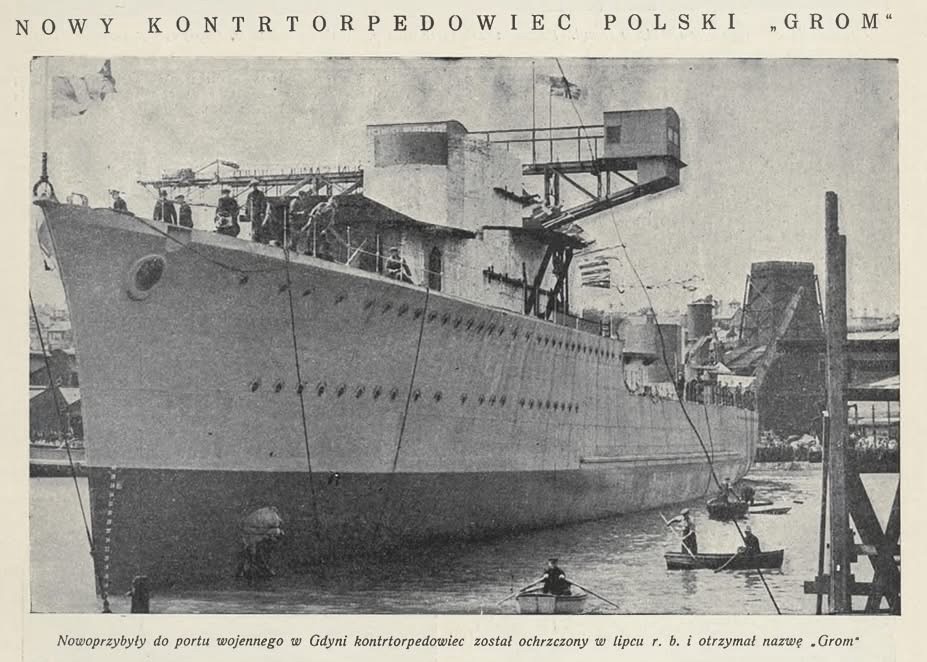
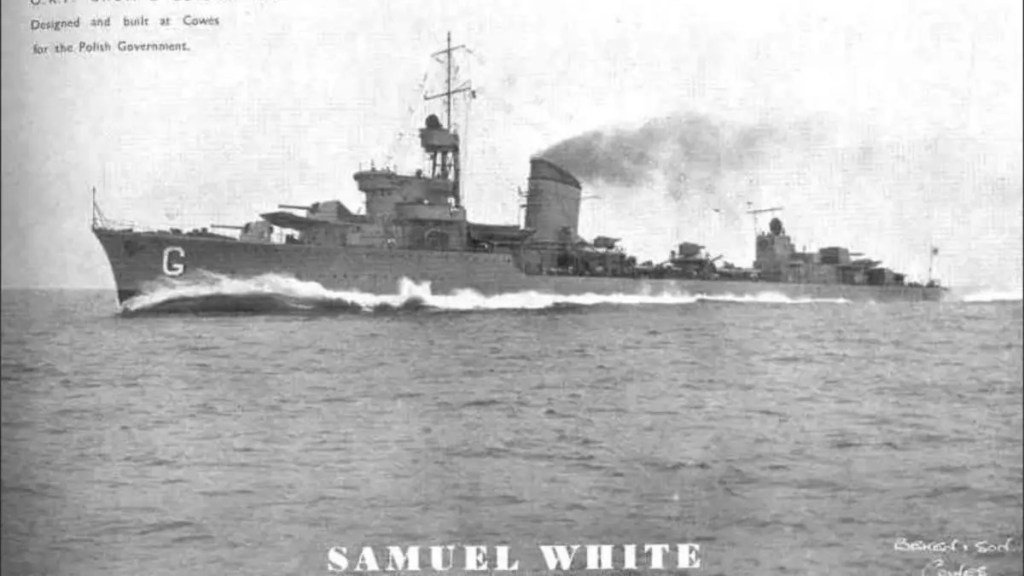
20 July 2026 marks the 90th anniversary of the launch of ORP Grom, one of the most powerful and modern destroyers of the Polish Navy before the outbreak of the Second World War. Built in the British shipyard J. Samuel White & Co. in Cowes on the Isle of Wight, ORP Grom became a symbol of the close naval cooperation between Poland and the United Kingdom.
A New Generation of Polish Destroyers
During the early 1930s, the Polish Navy sought to modernise its fleet by acquiring fast and heavily armed destroyers, then known as torpedo-boat destroyers. Their primary role was to defend Poland’s Baltic coastline, protect vital maritime supply routes, and engage larger enemy vessels if necessary.
After unsuccessful negotiations with French and Swedish shipyards, and a proposal from John Thornycroft & Co. that exceeded Poland’s budget, the contract was awarded to J. Samuel White & Co. in Cowes.
On 29 March 1935, Poland signed a contract for the construction of two destroyers: ORP Grom and ORP Błyskawica. At Poland’s request, the original British design was modified, particularly by strengthening the ships’ artillery armament.
Construction of ORP Grom began on 17 July 1935, when her keel was laid. The destroyer, carrying shipyard number 1800, was officially launched on 20 July 1936.
A Ceremony in Cowes
The launch ceremony took place at noon at the Cowes shipyard and was attended by distinguished guests from both Britain and Poland.
The ship’s godmother was Wanda Poznańska, wife of Karol Poznański, the Consul General of the Republic of Poland in London. As ORP Grom slid into the waters of the River Medina, the Hampshire Regiment Band performed the Polish national anthem, highlighting the close friendship between the two nations.
One of the Fastest Destroyers of Her Time
Measuring 114 metres in length with a standard displacement of just over 2,000 tonnes, ORP Grom was among the fastest destroyers in Europe.
Powered by engines producing 54,000 horsepower, she achieved an impressive 39.49 knots during sea trials.
Her armament reflected international cooperation:
- Seven 120 mm Bofors guns from Sweden,
- Four 40 mm anti-aircraft guns,
- Two triple torpedo launchers supplied by Britain,
- French-made torpedoes and naval mines,
- Numerous electrical, radio and auxiliary systems manufactured in Poland.
The combination of speed, firepower and modern technology made ORP Grom one of the strongest destroyers operating in the Baltic Sea.
Entering Service
The Polish naval ensign was raised aboard ORP Grom on 11 May 1937, with Commander Stanisław Hryniewiecki appointed as her first commanding officer.
Following sea trials, the destroyer sailed to Gdynia, stopping in Gothenburg to collect ammunition for her Bofors guns before arriving in Poland on 16 May 1937. She officially entered service with the Polish Navy later that month.
Operation Peking
As war became inevitable, the Polish Navy implemented Operation Peking.
On 30 August 1939, just one day before Germany invaded Poland, ORP Grom, ORP Błyskawica, and ORP Burza departed Gdynia for Britain. The decision ensured that Poland’s most valuable destroyers would avoid destruction in the Baltic and continue the fight alongside the Royal Navy.
After arriving in the United Kingdom, ORP Grom undertook convoy escort missions and patrols in the North Sea, covering approximately 15,000 nautical miles, completing 20 patrols, and escorting 11 convoys.
The Battle of Narvik
In April 1940, ORP Grom joined Allied operations during the Norwegian Campaign.
Operating in the waters around Narvik, the Polish destroyer bombarded German positions and supply routes with remarkable effectiveness. According to wartime accounts, German troops reportedly referred to her as the “Cursed Pole” because of the devastating accuracy of her artillery fire.
On 3 May 1940, Grom was damaged by German coastal artillery but quickly returned to action after emergency repairs, firing around 500 rounds from her main guns during a single day’s operations.
The following morning, 4 May 1940, tragedy struck.
A German Heinkel He 111 bomber attacked the destroyer, dropping six bombs. Two direct hits caused catastrophic damage, and ORP Grom sank within minutes in the Rombakken Fjord.
Fifty-nine members of her crew lost their lives, while survivors were rescued by nearby Royal Navy vessels.
A Lasting Legacy
Today, the wreck of ORP Grom rests at a depth of approximately 115 metres in Norwegian waters. Her broken hull remains a silent memorial to the courage and sacrifice of the Polish sailors who fought alongside the Allies.
Ninety years after her launch in Cowes, ORP Grom continues to symbolise the professionalism of the pre-war Polish Navy, the enduring Polish-British alliance, and the bravery of those who served under the White and Red naval ensign during the Second World War.
As we commemorate this important anniversary, we honour the memory of the officers and sailors of ORP Grom, whose service and sacrifice remain an enduring chapter in both Polish and British naval history.
Lest We Forget. 🇵🇱🇬🇧
Text : Iwona Golińska. President of Polish Sue Association.



Leave a Reply