
By Polish Sue
On 1 September 1939, the Second World War began with Nazi Germany’s invasion of Poland.
In the early hours of that morning, German aircraft appeared over the Polish town of Wieluń.
What followed became one of the most notorious examples of the bombing of civilians at the very beginning of the war.
Wieluń was not a fortified military centre. Before the war, approximately 16,000 people lived there. The town was only around 21 kilometres from the German border and had no significant military installations or organised air-defence system.
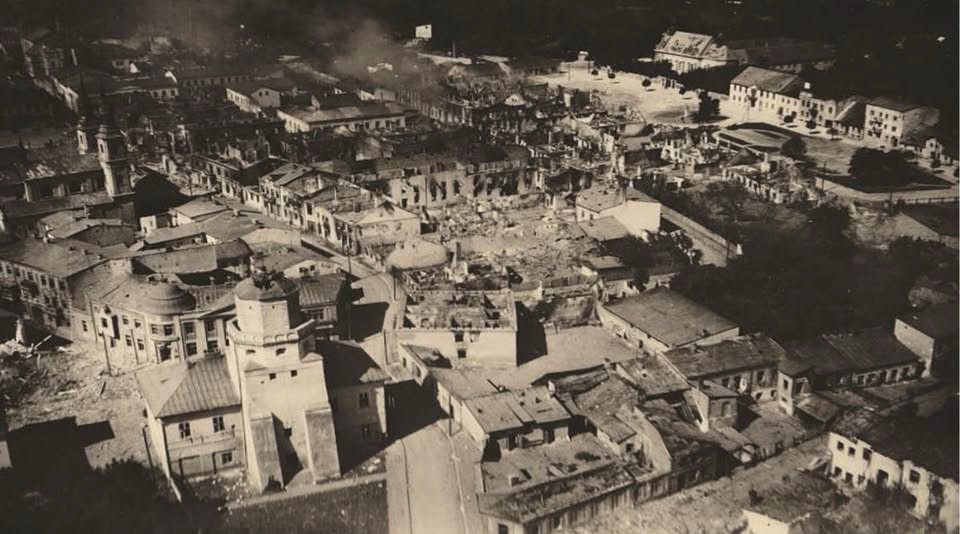
There was no battlefield in Wieluń.
There were ordinary homes , streets, shops, places of worship — and a hospital filled with patients.
🛩️ The bombs fall
At dawn, German Junkers Ju 87 Stuka dive bombers attacked the town. The bombing was carried out in repeated waves and continued for hours.
Historical estimates indicate that approximately 380 bombs, weighing around 46 tonnes, were dropped on Wieluń.
The destruction was immense. Around 75% of the town was reduced to ruins, including much of its historic centre.
One of the buildings struck was All Saints’ Hospital, despite its Red Cross markings.
The parish church was damaged and the synagogue was destroyed. Homes and civilian buildings were hit, while people who had expected to wake to an ordinary September morning suddenly found themselves living through the opening hours of war.
For the people of Wieluń, there was no warning.
Death came from the sky.
🕯️ How many died?
The precise number of victims remains disputed by historians. Estimates range from several hundred to more than 2,000 people killed.
But behind every number was a human being.
A mother.
A father.
A child.
A patient in hospital.
A neighbour.
A member of a family whose life was destroyed forever.
Wieluń therefore became much more than a location on a map. It became a symbol of the vulnerability of civilians when warfare is directed against populated areas.
🇵🇱 Wieluń was only the beginning
The bombing of Wieluń must be remembered in the wider context of what happened to Poland between 1939 and 1945.
The attack on Wieluń was one of the first acts of a German war and occupation that would bring unimaginable suffering to the Polish nation.
Across Poland, millions of Polish citizens were murdered. People were executed in mass killings, imprisoned, deported and subjected to forced labour. Jewish citizens of Poland were targeted for annihilation in the Holocaust.
Polish cities and villages were destroyed. Cultural institutions were looted. Libraries, museums, archives and works of art were stolen or deliberately destroyed. Families were torn apart and entire communities disappeared.
The destruction of Warsaw became one of the most devastating examples of this policy. After the Warsaw Uprising of 1944, the German forces systematically destroyed large parts of the city.
Wieluń was therefore not an isolated tragedy.
It was the beginning of a catastrophe that would engulf the entire country.
💰 The question of German reparations
The enormous losses suffered by Poland during the entire Second World War and German occupation from 1939 to 1945 also remain at the centre of an unresolved historical and political dispute.
In 2022, a Polish parliamentary report estimated Poland’s losses resulting from German aggression and occupation at approximately PLN 6.2 trillion.
These losses concern the entire country and the entire period of German aggression and occupation — not Wieluń alone.
They encompass the enormous human and material destruction suffered by Poland: the loss of life, destruction of property and infrastructure, economic exploitation, forced labour, looting, destruction of cultural heritage and the devastation of Polish cities and communities.
Germany maintains that the question of reparations has been settled and rejects Poland’s present demands for compensation.
Poland maintains that the issue has not been adequately resolved and continues to demand that Germany address the consequences of the enormous losses inflicted upon Poland during the war.
For Poland, this is not simply a question of money.
No financial payment could ever compensate a family for the murder of its children. No amount could bring back those killed in Wieluń or restore the lives destroyed throughout Poland.
The question is also about responsibility, remembrance, justice and recognition of historical truth.
🕯️ Remembering Wieluń
Today, when we remember 1 September 1939, we remember more than the date on which war began.
We remember the people of Wieluń.
We remember the civilians who died under the bombs.
We remember the patients in the hospital.
We remember the destruction of the town.
And we remember the millions of Polish citizens whose lives were destroyed during the German war and occupation.
The story of Wieluń reminds us that the Second World War did not begin as an abstract military conflict.
For ordinary people, it began with bombs falling from the sky.
Their memory deserves to be preserved.
Their suffering deserves to be remembered.
And the history of what happened to Poland between 1939 and 1945 must never be forgotten.
🕯️ Wieluń – 1 September 1939.
We remember. We honour the victims. We will not forget.
🇵🇱 Polish Sue – remembering Polish history in Britain and beyond.
Text: Polisb Sue
Pictures: IPN
#Wieluń #1Września1939 #WWII #Poland1939 #PolishHistory #Luftwaffe #GermanOccupation #PolishReparations #RememberWieluń #NeverForget #PolishSue



Leave a Reply